Sequest has set out on a mission of leveraging extreme desert dryness to unlock a new carbon dioxide removal (CDR) approach.
The startup intends to store agricultural residue in the desert in custom-engineered chambers with low moisture levels that will prevent the biomass material from decomposing and releasing CO2 into the atmosphere.
Following the same concept that preserved date palm, grain, and linen for thousands of years in Egypt’s desert tombs, where the air is too dry to support decay-causing microbes, Sequest will use extreme dry desert conditions to tackle atmospheric CO2 emissions.
To date, the company’s approach has successfully completed a Preliminary Assessment by established durable carbon removal registry Puro.earth.
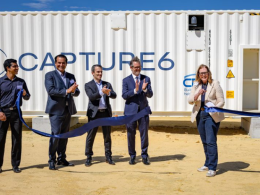
Now, Sequest is gearing up to launch its first commercial facility, called Horizon, which is expected to come online in Saudi Arabia this year.
Agriculture produces more than seven billion tonnes of crop waste material a year, and a large portion of it is left to rot, releasing the CO2 originally captured by plants back into the atmosphere.
Sequest breaks this cycle by storing residual agricultural biomass in engineered above-ground chambers in hyper-arid environments. The patent-pending chambers hold the biomass in an environment with low rainfall and low humidity, where the moisture levels prevent the proliferation of microbes that could break it down.
Relevant: Carbonsate Marks First Credit Issuance From Its Puro.earth-Certified Biomass Storage Project
Sequest’s future plans and expectations
By using existing industrial processes such as biomass handling, trucking, earthworks, and environmental monitoring, Sequest expects to reach a low cost per tonne of CDR in the short term rather than after years of working down a cost curve.
As shared by the startup, its inaugural Horizon facility will operate with an initial target of 1,000 tonnes of net carbon removal, with plans to expand capacity and international credit availability following its first credits issuance.
In the meantime, Sequest has entered partnerships with leading Saudi Arabian institutions that will enable land access for the Horizon facility, as well as the distribution of credits within the Kingdom.
Read more: Carbon Business Council Launches A Direct Storage Of Biomass Coalition