We sat down with Rory Brown, CEO of Airhive, a company making bold moves in the direct air capture (DAC) space.
Airhive is developing an innovative, low-energy approach to carbon removal, with an ambitious goal of capturing 1 million tons of CO2. Rory shares insights on how strategic partnerships — including collaborations with Coca-Cola, Deep Sky, and others — are helping Airhive accelerate its technology and scale its impact.
We also dig into why strong market demand is critical for carbon removal to reach meaningful scale, and what it will take for DAC to move from niche innovation to a core pillar of climate action.
How did the idea for Airhive come about?
After working in a number of low income and conflict-affected countries in Africa and Asia in the 2010s, it was clear and obvious that climate change was a tangible fact of life in these countries and was contributing to a myriad of challenges they face – poverty, political violence, weak governance etc.
I moved back to the UK just before the lockdowns with an intent to formally study climate change, and in 2020 did a climate and energy-focused degree at University College London while working in what was my final job in my old career. It was a brilliant degree, and one key takeaway was how much the climate models that chart pathways to limiting temperature increases to Paris Agreement levels rely on technologies that remove carbon from the atmosphere; the numbers for what we need this century are pretty sobering, and almost certainly understated because the models also assume a pace of decarbonisation that has not been demonstrated in practice.
Relevant: Deep Sky, Airhive To Deploy Direct Air Capture Unit in Canada
But this was at a time when these removal technologies were few and barely out of the lab. So I thought maybe I could build something better. I am not, however, an engineer, which you pretty much do need to be to create a new technology. So in 2022 I went hunting for co-founders, and was lucky enough to meet Jasper, who was finishing his PhD in industrial decarbonisation. We spoke about direct air capture, which I was convinced was the most scalable of the removal technologies, and it triggered some ideas in his mind; remarkably, the core technology concept has not really changed from those first ideas, although they have gone from a few equations to some pretty large pilots in less than three years.
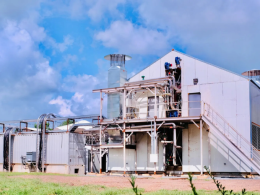
Since starting in the summer of 2022, we’ve gone from garage prototype to installing our first demonstration system in Alberta, Canada at present, which will be one of the largest DAC systems in the world and one whose unit economics and resource uses (energy, water, capture materials) we think stack up really well against what else is out there. We’ve also built strategic partnerships to decarbonise products, including a partnership with Coca-Cola Europacific Partners to provide air captured carbon dioxide for fizzy drinks through a large commercial pilot at one of their bottling plants in Europe.
What makes Airhive unique?
Our technology USP comes through the use of something called a fluidised bed. This is a type of process technology commonly used in industry for applications such as mineral processing and drying foods and medication, and is particularly good at contacting gases and solids efficiently.
We’re using them in a very unusual way to process large amounts of air with limited energy inputs in a very small box, squeezing down both CAPEX and OPEX. And by using a well-understood and widely used technology with mature supply chains, we’ve been able to move pretty fast on both deployments and in pushing the technology down the cost curve.
Tell us about the food-grade CO2 you produce. How is this process different from your regular DAC process?
We expect our technology to produce very pure carbon dioxide right out of the regeneration system—typically above 98%—thanks to two key factors: we don’t burn any fuels during capture, and we use non-toxic, non-hazardous sorbent materials.
This means the remaining impurities are mostly benign substances, such as nitrogen and water vapour, rather than harmful contaminants like SOx or NOx that can be found in other processes. This clean profile makes it significantly easier to purify our CO₂ to meet food-grade standards of 99.99% purity. We achieve this through a straightforward post-processing step that primarily focuses on removing residual water vapour.
Relevant: Airhive Closes A Pre-Seed Round With Coca-Cola On Board
Overall cost matters too, because food-grade CO2 is already a commercially available industrial gas. So a lower price point for a company using the CO2 in their production process is also obviously important.
I think both of these elements contribute to our technology being attractive to businesses like Coca-Cola Europacific Partners, who invested in us in 2023. By installing our DAC systems at food and beverage production facilities, companies can directly capture atmospheric CO₂. If we can get that to a price point that is lower than the CO2 they already procure, then we are providing them cleaner CO2, at a lower price, and with greater supply certainty.
Are you currently providing carbon for sustainable aviation fuel and/or green methanol? What is the demand for these products like at the moment and where do you see it headed in the future?
Not yet. I think e-fuels are an exciting area of innovation in aviation and shipping. The sector is still early, but because of policies like the UK and EU 2030 SAF mandates, there is a sense of a rapidly growing demand – although as with so much of the innovation landscape it will probably take much longer than people think to bring online the many many projects that’d be needed to meet such medium-term targets.
There are a couple of key advantages that air captured CO2 has as a feedstock into the production of those e-fuels. One is that if you are producing green hydrogen onsite, that presupposes that there is green power that could also be used to produce the CO2, which is a much smaller overall input in the production process. And because CO2 is a small relative input, even if DAC is more expensive than other sources of CO2, the overall price of the fuel doesn’t move around a lot at different CO2 price points. So as a technology that can be sited at the fuel production plant, DAC would give you scalability, synergy with the rest of the process, and security of supply.
What are some of the key partnerships or collaborations that have been vital to Airhive’s success so far?
We’re very proud to be working closely with both AP Ventures and Coca-Cola Europacific Partners (CCEP), who both came onboard to support Airhive during our pre-seed funding round in 2023. We also have a key project partnership with Deep Sky, which develops and operates large-scale carbon removal projects using various technologies, as well as additional project partners we cannot yet name but are excited to announce if and when we greenlight those projects. We’ve also been very grateful for the support of one of our first customers Frontier, and the recognition as a Top 20 finalist for the XPRIZE Carbon Removal, which pushed us to bring our 1,000 tonne per annum demonstration plant on faster than we had planned.

Airhive has set out to remove 1 million tons of CO2 annually by 2030. How do you plan on achieving that scale?
Let’s say 1 million tons in 2030 is a stretch target. But if we’re talking practically speaking about large scale as soon as we can, there are a few key steps. The first is developing our standardised module and proving that works in first commercial projects; while we expect to innovate and iterate designs across projects, that first standardisation is crucial for bringing down technology risk.
Next is building out our project execution capability, which wraps in site development, technology, supply chain, construction, commercial and financing. Startups typically start as technology companies but we ultimately have to deliver projects, and that is a very different, and equally difficult, practice; even mature organisations can routinely deliver projects badly.
Beyond having those capabilities, the key limiting factors to reaching that kind of scale will be demand for the removal credits, and financing – and those two are closely connected, as without bankable offtake contracts from buyers it will be impossible to get the debt financing that major capital projects like these need to be developed.
The UK government’s carbon capture approach has recently come under fire. How do you see this affecting carbon capture and removal in the country?
There has been a debate for decades whether governments should support carbon capture, and the rationale for it has shifted in that time; initially the concept was more focused on capturing emissions from power plants, and more recently this has shifted to decarbonising heavy industry as clean energy has made such progress on the energy generation side.
There aren’t yet good alternatives to existing ways of producing things like cement and steel at large scales, so retrofitting existing industrial facilities with point source capture remains an important part of the UK’s and other countries’ decarbonisation path.
In the last decade, the emergence of removal technologies like DAC and BECCS means there is an additional rationale for the development of the CO2 transportation and storage infrastructure needed for point source carbon capture. I think the UK and other governments get this, and will proceed even as robust debate over how much we invest in carbon capture or any other transition technology continues.
What is your view on the development of carbon markets and their importance for CDR?
We won’t scale these technologies without demand; you can’t sell a product that no one wants to buy. There has been some great progress from companies and coalitions of companies like Frontier in creating early demand that has allowed the market to go from non-existence to existence in the past decade.
But at some point it will be necessary for government-regulated markets to be created that contribute to properly pricing carbon emissions. A few countries are looking at compliance markets, notably Japan and the UK, and I think there will be a few by the early 2030s. Design is tricky though; combining them with emissions allowances in an emissions trading system seems complex and challenging to me, and you have to be careful not to just be a dead weight on important industrial sectors that are critical for supporting jobs, consumption and economic growth. From the experience of the EU’s ETS, it could well take a couple of iterations and some significant setbacks and tweaks to figure out a viable market arrangement.