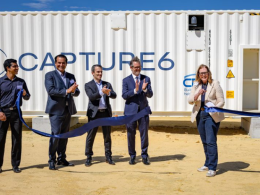
Earlier in July Vesta, a public benefit company focused on ocean carbon removal, announced it has deposited 8,200 metric tons of carbon-absorbing olivine sand near the shoreline of Duck, North Carolina.
The company recently became the first applicant to receive permits for a standalone ocean-based carbon removal pilot and this project marks a pivotal moment in the development of its Coastal Carbon Capture™ approach.
Following the green light from the North Carolina Department of Environmental Quality and the U.S. Army Corps of Engineers, as well as an extensive consultation with the local community, the trial is expected to ultimately remove around 5,000 tons of CO2.
“We chose the location primarily because it’s actually one of the best studied coastlines in the world. And the U.S. Army Corps of Engineers has their field research facility in Duck, NC,” says Vesta CEO Tom Green.
The raw material
Vesta’s approach relies on a mineral with a specific set of properties – olivine. When mixed with seawater a chemical reaction is started, increasing seawater alkalinity and turning CO2 into bicarbonate, which seashells and corals use to form their calcium carbonate shells and skeletons. This reduces the carbon concentration in surface waters and causes them to “pull” more CO2 from the atmosphere to balance our the deficit created by the process.
But is there enough olivine to have a substantial impact?
“Olivine is one of the most abundant minerals on the planet, it is found all over the world, there are hundreds of billions of tons of it in the ground. There is more than enough for us to progress and to get to a really large scale,” explains Tom Green.

The potential for scale
Carbon dioxide removal is on track to become a sizeable market in its own right, with over $2.7 billion changing hands already according to CDR.fyi. But the Vesta approach to carbon removal has an additional component to it – coastal protection.
Green highlights this by saying: “One of the reasons we’re focused on coastal systems is the coastal protection angle. We think about it as a dual solution – a climate resilience or adaptation solution alongside a mitigation solution by removing carbon dioxide. Our business model is to first provide cost effective sand for coastal communities that are facing a shortage of sand. One side of it is that it helps communities do coastal protection. The other side, of course, is that we plan to sell carbon removal [credits].”
Coastal erosion can significantly impact economies at the local, regional, and national levels. In the United States, this issue leads to approximately $500 million in property losses along coastlines each year, according to federal data.
Relevant: Vesta Launches Its Southampton Demonstration Site – The First Carbon Capture Beach
The National Coastal Resilience Fund anticipates awarding approximately $140 million for coastal resilience projects, $93 million of which comes from the Bipartisan Infrastructure Law with investments expected to continue at these levels in 2025 and 2026.
These two aspects to the business model offer the opportunity to reduce the risk and tap into growing demand from states and municipalities looking for ways to reduce the loss of land and damage to property.
“We’re particularly excited about some project opportunities in the Gulf of Mexico and the Southeastern U.S., where there is a significant coastal erosion problem and a need for sand. We are working with stakeholders there to determine a site for our next project,” adds Green.
Science-led approach
Similar to all other carbon removal approaches this is new ground in terms of science and Vesta has placed a strong emphasis on researching the impact of coastal carbon capture since its start in 2019, evidenced by its detailed website section describing the numerous studies it is involved with.
“We have a lot of belief that this is a solution that, if done correctly, can be deployed safely. And at the same time, we need to take all the measurements and let the data speak. And that’s certainly the attitude of our scientific collaborators as well,” emphasises Green.
Ocean carbon removal’s potential has become clear in recent years with startups trialing a wide range of approaches from sinking biomass to treating waste water. This prompted over 400 scientists to call for setting standards for field trials, signaling that the field is maturing.

mCDR policy taking shape
The policy front has also seen progress with the White House forming a Fast-Track Action Committee on marine CDR, while the DOE and NOAA have signaled they will work together on research.
The Carbon Business Council also recently published an issue brief, highlighting the mCDR opportunity, identifying pathways to enable research, development, and deployment; and offer a set of focused recommendations for policymakers and other CDR ecosystem stakeholders to responsibly accelerate the advancement of mCDR.
“To us responsibility, whether that is scientific transparency, or engaging with the communities, goes hand in hand with growth. They’re not trade-offs with each other, because we take the fact that we’re operating in the public commons incredibly seriously. Recognizing that sharing what we’re finding with the world, and working hand in hand with communities where we’re doing projects is essential to scaling this approach. You just can’t sacrifice one [of them],” says Zach Cockrum, VP of Policy and Partnerships.