
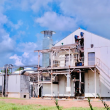


The UK government and Italian energy giant Eni have approved a 38-mile carbon capture pipeline that will begin operating in 2028, transporting industrial CO2 emissions from the Liverpool-Manchester region to storage sites beneath the seabed in Liverpool Bay.
The pipeline is a central component of the HyNet North West industrial cluster, which will also include hydrogen production facilities to decarbonize local manufacturing.
Initially, the pipeline will store 4.5 million metric tons of CO2 annually — scaling to 10 million metric tons after 2030, equivalent to the emissions of around 4 million cars. The announcement was made by Labour leader Sir Keir Starmer at an energy summit in London.
The UK Secretary of State for Energy Security and Net Zero, Ed Miliband, said: “This investment from our partnership with Eni is government working together with industry to kickstart growth and back engineers, welders and electricians through our mission to become a clean energy superpower. We are making the UK energy secure so we can protect families and businesses and drive jobs through our Plan for Change.”
While Eni hasn’t disclosed the full cost of the project, the UK government previously pledged nearly £22 billion ($29.2 billion) over 25 years to support HyNet and the Net Zero Teesside initiative.
HyNet’s backers claim the project will help safeguard 350,000 manufacturing jobs and generate £17 billion (~$22.6 billion) in regional economic value.
Relevant: Eni Unveils Carbon Capture Division and Data Center Power Plans
However, concerns remain that government funds are being stretched thin, leaving limited support for other carbon capture projects in the Humber and Scotland.
“The strategic agreement with the UK Government paves the way for the industrial-scale development of CCS, a sector in which the United Kingdom reaffirms its leadership thanks to the promotion of a regulatory framework that aims to strengthen the development of CCS and make it fully competitive in the market,” said Eni CEO Claudio Descalzi.
“Eni has established itself as a leading operator in the UK thanks to its key role in CO2 transport and storage activities as the leader of the HyNet Consortium, which will become one of the first low-carbon clusters in the world.”
Read more: UK Greenlights $250M Viking Carbon Capture Pipeline Project