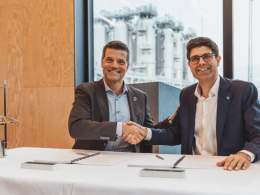
By Alexander Mäkelä and Valter Selén
2025 is the year we start talking honestly about carbon removal – not as a lofty ambition nor a theoretical solution, but rather as an urgent, practical necessity. Carbon removal is about balancing carbon budgets, addressing hard – to – abate residual emissions, and ultimately removing more carbon from the atmosphere than we emit.
Carbon removal is also a strategic sector for national governments and international bodies (think EU), providing an opportunity to combine real climate impact with economic development. Here’s a reality check: while leading international initiatives like the Science – Based Targets initiative (SBTi) capture headlines, much of the real, tangible action right now – and for the near – term future – is happening at national and regional levels. Specifically, it’s happening in Europe.
Let’s set the record straight. The European Union deserves genuine credit. Despite operating at capacity – and often beyond it – a handful of units at the European Commission have courageously advanced major carbon removal – related policies. Initiatives like the Carbon Removals and Carbon Farming Framework (CRCF) and the Green Claims Directive are poised to move the needle forward. Incoming initiatives like the Clean Industrial Deal and the high – profile reform of the EU Emissions Trading System (EU ETS) also show real promise. But the sober truth remains: policy ideas in Brussels typically require four to seven years to go from inception to actual implementation. For an industry fighting against climate deadlines, return – hungry capital, and the start – up valley of death, a seven – year wait feels like an eternity.
It’s tempting to look to the U.S. as a potential alternative source of momentum. But across the Atlantic, the outlook is becoming increasingly uncertain. Initially, the U.S. Department of Energy’s Direct Air Capture (DAC) hubs were beacons of global leadership. But recent months have seen troubling setbacks, most notably the Department of Energy FECM has lost part of its CDR team. While landmark policies like the 45Q Tax Credit remain, the political situation is increasingly in question. Losing influential actors significantly weakens industry momentum precisely when bold policy support and pragmatic public interventions are most needed.
So, what now?
Enter National Ambition
Fortunately, some European nations aren’t waiting. Countries like the Netherlands and Germany have already started forging ahead. With its legally binding net – zero target by 2045, including CDR, Germany is currently developing a dedicated CDR strategy (Langzeitstrategie Negativemissionen) and has already set legal reforms in motion to enable offshore CO₂ storage and cross – border CO₂ transport while addressing critical investment bottlenecks with the planned €100 billion special climate fund. Netherlands and Austria could become proactive leaders through targeted policy instruments and sophisticated national initiatives. The Netherlands recently published a CDR Roadmap, which strategically assesses the role of CDR alongside emission reduction, while Austria released a comprehensive carbon management strategy with a big focus on CDR. These nations aren’t just patching holes – they’re doing the groundwork to become the regulatory laboratories for carbon removal. But the most coordinated and exciting momentum right now pointing towards national industrial policy for carbon removal is emerging in the Nordics.
National Industrial Policy Isn’t Optional
Market growth demands more than demand stimulation alone – it demands coordinated, pragmatic industrial policy. Industrial investments face long lead times and high upfront risks, and companies need clear, stable rules of engagement. Regulatory frameworks that streamline permitting, spur innovation, and enable industry hubs are critical to attracting and sustaining sector growth. Equally important are clear regulatory signals that guarantee demand, such as ambitious climate targets and effective compliance markets. Germany and France, for instance, have successfully aligned their industrial capabilities with supportive policy frameworks. Yet despite these individual successes, Europe’s overall carbon removal ecosystem remains fragmented, scattered across multiple borders.
Nowhere is the potential for unified, integrated industrial policy clearer – or more essential – than in the Nordic countries. Each Nordic nation brings unique strengths to the table. Just as a few examples, Sweden and Finland offer exceptional conditions for biomass – based carbon removal, given their abundant and sustainably managed forestry resources. Norway and Denmark, meanwhile, have significant geological advantages, notably extensive offshore CO₂ storage capacity. Iceland, together with Norway and Denmark, is particularly well – positioned for Direct Air Capture thanks to renewable energy availability, suitable geology, and a strong innovation ecosystem.
Leveraging these distinct national advantages through integrated regional policy creates significantly more efficient, resilient value chains. By jointly addressing structural value chain issues – like shared CO₂ transport and storage infrastructure or sources of sustainable biomass – the Nordics reduce risk, spread costs, and improve economic viability.
But successfully building this integrated infrastructure also demands clarity around the technologies involved. Here’s why precision matters: although related and complementary, Carbon Capture and Storage (CCS), Carbon Capture and Utilization (CCU), and Carbon Dioxide Removal (CDR) each have fundamentally different goals and impacts. CCS captures emissions directly from industrial sources, preventing additional CO₂ from entering the atmosphere; CCU repurposes captured carbon into usable products; and CDR actively removes CO₂ already present in the atmosphere, delivering net – negative emissions. Explicitly understanding these distinctions matters greatly for policymakers, as confusion can lead to misallocation of funding, infrastructure misalignment, and ineffective risk management.
Despite their differences, CCS, CCU, and CDR benefit enormously from shared infrastructure – pipelines, storage facilities, transportation hubs – which can significantly reduce investment risk and lower costs. Integrating multiple carbon management streams not only boosts infrastructure utilization but also accelerates commercial viability across all technologies. Given the Nordics’ already robust experience with CCS and CCU, the region holds unique potential to integrate and rapidly scale Direct Air Capture and Bioenergy with CCS (BECCS), positioning itself as a credible and pragmatic leader in integrated carbon management.
Recognizing potential is one thing – unlocking it with real – world action is another. Practical questions immediately arise: How can policymakers and industry players quickly translate Nordic strengths into scaled – up, profitable ventures? Here’s where finance and policy levers come into play.
Small Policy Levers, Big Financial Leverage
When discussing investments in carbon removal, precision matters. People throw around the term “investment” loosely, but what exactly do they mean? Are they talking about direct government commitments like multi – year procurement contracts or targeted research grants? Do they mean public – sector interventions – such as blended finance mechanisms or loan guarantees – that leverage private – sector capital by reducing risk? Or are they referring to purely private investments like venture capital (seed funding, Series A/B rounds) where investors seek returns directly? Each of these investment types brings unique leverage, distinct policy considerations, and fundamentally different implications for scaling carbon removal.
Take public procurement, for example. On its surface, it means governments purchasing carbon removal services. But procurement, done right, packs significant financial leverage. When governments commit to long – term contracts, startups gain predictable cash flows, enabling them to secure favorable debt financing instead of repeatedly chasing venture capital. This transforms ambitious startups into credible, investment – ready businesses, significantly improving their scalability. Moreover, explicit governmental backing signals credibility to voluntary carbon markets and private investors, accelerating technology toward commercial scale (Nth-of-a- Kind or NOAK).
However, it’s also crucial to recognize that different policy levers are best suited to different governance levels. Some interventions – such as international standards or trade regulations – naturally align with global or EU – level policy. Others, like public procurement and infrastructure investments, typically see their strongest effects at national or even subnational levels. Cities, for instance, can set local procurement mandates, and corporations can make internal carbon removal commitments.Industrial policy must therefore be nuanced and strategic, matching each policy tool to its most effective point of leverage in the value chain – a point we’ll clearly expand upon in the upcoming Nordic Carbon Removal Association’s flagship report (launching June 3rd), and in Carbon Gap’s forthcoming industrial policy brief for carbon removal.
Financial tools alone won’t guarantee a unified market or sustained momentum. Coordination is essential – particularly at the regional level – to clearly match policy instruments to the right governance layers. This coordinated, pragmatic approach is precisely what the new Nordic Carbon Removal Association aims to provide, ensuring industry voices across the Nordics speak collectively, strategically, and credibly.
Launching the Nordic Carbon Removal Association
On June 3rd, we’re officially launching the Nordic Carbon Removal Association – and releasing our flagship Nordic CDR report. Building on the region’s proven leadership in climate action, carbon removal is the logical next frontier. Our ambition is clear: build a thriving regional carbon removal industry, drive sustained demand, and position the Nordics as serious contenders in the global CDR landscape. Achieving this demands meaningful cross – border collaboration, drawing on the unique strengths each Nordic country brings to the table.
Right now, the Nordic carbon removal industry is young, promising, but fragmented. The association fills this gap by providing a unified voice – one policymakers can trust. We’re not replacing existing efforts; we’re amplifying and coordinating them, aligning industry needs directly with government priorities.
What sets this association apart is its clear focus on practical deployment rather than creating broader consensus around principles or conducting purely academic research – areas already well covered by other organizations. Instead, we will advocate for regulatory frameworks that clearly unlock deployment at scale, while directly supporting targeted industrial policy actions, robust infrastructure strategies, and stronger value chain integration across the Nordic region. The goal is concrete: remove barriers, establish clarity, and accelerate real – world build – out of carbon removal capacity.
The Nordic CDR report, launching simultaneously, is a comprehensive strategic blueprint serving as a practical playbook for policymakers and industry stakeholders. It clearly outlines how carbon removal can unlock major economic potential, drive GDP growth, create high – quality jobs, and dismantle current barriers to scaling. Think of it as your essential guide for building a genuinely competitive, integrated Nordic carbon removal industry from day one.
National initiatives alone aren’t sufficient. To truly scale carbon removal, the Nordics must also align closely with EU – level frameworks and clearly understand the rules of engagement set in Brussels – particularly standards and compliance obligations critical to industry growth. Rather than shaping broad EU policy from scratch, the Nordic Carbon Removal Association will ensure that Nordic industry players effectively navigate existing EU frameworks, clearly communicate Nordic – specific needs, and leverage relevant EU support programs and consortia. This approach ensures practical alignment between Nordic actions and EU rules, unlocking the region’s full potential.
The Nordic Way Forward
We’re past debates on whether we need carbon removal. Now it’s about rapid execution – leveraging proven policy levers, pragmatic regional cooperation, and clear market incentives to scale viable technologies at unprecedented speeds.
The Nordic approach can serve as a blueprint for Europe and beyond. Pragmatic execution, backed by targeted policy tools and a willingness to leverage existing infrastructure creatively, offers a replicable model that other regions could – and should – follow.
Ultimately, while big ideas matter, real – world execution matters more. Perhaps that’s the most Nordic lesson of all.
Bios
Alexander Mäkelä is Chief Policy Officer at Carbon Gap, leading European and global carbon removal policy advocacy. He previously worked on carbon management strategies at McKinsey & Company and recently co – founded the Nordic Carbon Removal Association as part of his Stripe Climate Fellowship.
Valter Selén leads Carbon Gap’s work developing policies to drive demand for high – quality carbon removal on the national and European level, catalysing the creation of a carbon removal industry in the Nordics through the launch of a Nordic Carbon Removal Association. With close to a decade of experience with EU policymaking, Valter has previously worked with the European Commission and industry actors to design the EU framework to decarbonise the maritime sector.
Read more: New Report Examines The Role Of Nordic Countries In Accelerating CDR And CCU