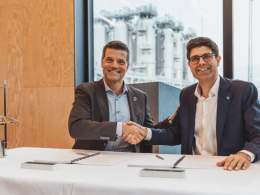
A Swiss bioenergy with carbon capture and storage (BECCS) project has secured a long-term carbon dioxide storage agreement with INEOS, marking a major milestone for cross-border CO2 transport and permanent storage in Europe.
The agreement brings together CO2 Energie AG and INEOS, operator of the Greensand Future CO2 storage project in the Danish North Sea. Facilitated by project developer Airfix, the deal enables the permanent storage of biogenic CO2 captured in Switzerland beneath the seabed of the North Sea, demonstrating the technical and commercial feasibility of international CO2 value chains.
The CO2 Energie project, led by RegionalWerke AG Baden and Recycling Energie AG, integrates biomethane production with BECCS technology. Once operational in the second quarter of 2026, the facility is expected to capture and transport more than 4,250 tons of biogenic CO2 per year for offshore geological storage at the Greensand site.
The project will become Switzerland’s first commercial initiative to store CO2 outside its borders and the only non-Danish project to secure storage capacity in Denmark, positioning it as a European first in cross-border carbon removal deployment.
Greensand Future advances Europe’s first full-scale CO2 storage hub
The agreement builds on more than two years of engagement between Airfix, CO2 Energie and INEOS. Over this period, the project has also secured early financial backing, including a commitment from the Climate Cent Foundation to purchase CHF 10 million worth of carbon removal credits.
With support from South Pole, Airfix has led carbon asset development, commercial structuring and partnership formation, enabling the project to reach a final investment decision in 2024.
On the storage side, Greensand Future reached its own final investment decision at the end of 2024, clearing the way for Europe’s first full-scale CO2 storage facility.
Relevant: INEOS Awards Score Major Carbon Capture Contracts For Project Greensand
The project will store CO2 in the INEOS-operated Nini West reservoir, approximately 1,800 metres (~5,906 ft) beneath the seabed, with Harbour Energy and Nordsøfonden as partners.
For Switzerland, the deal supports delivery of its binding net-zero target under the Climate and Innovation Act, which entered into force in January 2025.
More broadly, it provides a replicable model for combining BECCS technology, international transport infrastructure and private-sector financing to deliver durable negative emissions at scale.
Read more: Carbonfuture Opens Tender For Government-Backed BECCS Supply In Denmark