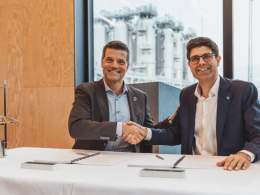
Höegh Evi, Aker BP and Ports of Stockholm have stepped up their collaboration to develop a dedicated CO2 logistics hub that will support an emerging carbon dioxide transport chain for industrial emitters across eastern Sweden.
The initiative builds on earlier feasibility work under the Norvik Infrastructure CCS East Sweden (NICE) project, which assessed infrastructure needs and commercial pathways for large-scale carbon transport.
The partnership, formally launched in May 2025, moves the effort into a more detailed design phase. The focus now is on defining the technical layout, capacity requirements and operational model for a logistics node at Stockholm Norvik Port, working closely with suppliers and participating companies to prepare for future investment decisions.

Building a Backbone for Sweden’s CCS Ambitions
Sweden’s national climate targets, most notably net-zero emissions by 2045, hinge on significant deployment of carbon capture and storage (CCS).
Höegh Evi noted that for industries across eastern central Sweden, a functional, scalable and reliable CO2 transport chain is essential to link captured emissions to long-term storage sites, whether domestic or cross-border.
“Stockholm Norvik Port is ideally located for CO2 collection, and is highly accessible for carrier ships transporting the CO2 to its permanent storage site,” said Nils Jakob Hasle, EVP Clean Energy in Höegh Evi.
“This has the potential to become a groundbreaking project that enables a robust, integrated, and scalable European CCS network and make a significant contribution to achieving EU and Sweden’s ambitious climate goals,” says Ørjan Jentoft, CCS Asset Manager at Aker BP.
Relevant: Storegga To Pull Out Of Acorn Carbon Capture Project
The effort also aligns with broader regional activity: in June 2025, Inter Terminals Sweden (ITS) and the Port of Södertälje launched a project to develop open, flexible CO2 infrastructure serving the wider Mälardalen region.
Across Europe, momentum is growing as countries work to establish multi-node CO2 transport networks, for example, the Netherlands is advancing five major CO2 infrastructure projects aimed at building a cross-border carbon storage and shipping system.
Together, these developments signal rapidly increasing coordination across the CCS value chain, with Stockholm Norvik Port emerging as a potential anchor point for eastern Sweden’s future CO2 logistics and storage ecosystem.
Read more: Technip Energies To Deliver Fully Electric CO2 Loading Arms For Northern Lights