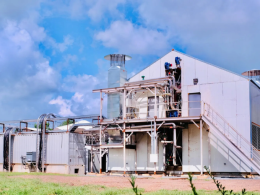
Saudi Arabia has successfully launched the first direct air capture (DAC) unit at the King Abdullah Petroleum Studies and Research Center (KAPSARC) in Riyadh, where it will serve to capture atmospheric CO2 emissions.
The pilot unit, designed by climate tech innovator Climeworks, was launched by Minister of Energy His Royal Highness Prince Abdulaziz bin Salman bin Abdulaziz.
Climeworks’ cutting-edge DAC technology has so far performed seamlessly in colder regions like Iceland, and this pilot deployment at KAPSARC will grant the possibility to explore the system’s capabilities in hot and arid climates like the one typical for Riyadh.
This milestone deployment is part of a larger-scale collaboration kicked off during the Saudi Green Initiative Forum in 2024.
At that time, a Memorandum of Understanding was signed on a feasibility study that would look into expanding the use of carbon capture technologies as a tool for advancing Saudi Arabia’s efforts towards net-zero.
KAPSARC, known as an advanced hub for carbon capture research, climate policy analysis, and energy innovation, was selected as the host location for the DAC unit due to its capacities for piloting and scaling this kind of decarbonization technology.
Positioned in an advantageous geographic location, Saudi Arabia offers a fertile growing ground for novel solutions like DAC, providing premium infrastructure and abundant renewable energy sources.
Recognizing these assets, the country is now setting out to evaluate DAC deployment and the potential for localizing key materials and components that can enable a domestic supply chain for decarbonization solutions.
Relevant: Aramco And Siemens Energy Launch The First DAC Test Unit In Saudi Arabia
The DAC technology pilot will lay the foundation for expanding the Kingdom’s carbon management operations.
Saudi Arabia has shared that by 2035 it intends to capture and utilize up to 44 million tonnes of CO2 on an annual basis through carbon capture utilization and storage (CCUS) hubs that would operate both in its eastern and western regions.
These hubs are envisioned to tackle industrial emissions that would then be converted and repurposed for usage in high-value products.
Read more: Microsoft Runs New DAC System Powered With Waste Heat From Its Data Centers