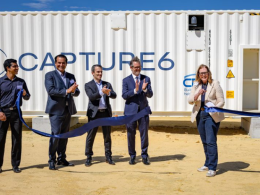
Return Carbon has partnered with the Permian Energy Development Lab (PEDL) on a new direct air capture (DAC) and CO2 storage test facility called the Trinity Campus.
Positioned in the U.S. Permian Basin, the Trinity Campus will serve as a site for validating novel DAC technologies under real-world field conditions.
Located in one of the globally prominent energy-producing regions, the development of Trinity is supported through a partnership with Roosevelt Resources, a long-standing energy producer in the Permian region.
During its initial operational phase, Trinity Campus is designed to be able to capture and store approximately 10,000 tons of CO2 emissions on an annual basis, and once it matures to Phase 2, the project is expected to capture between 100,000 and 500,000 tons of CO₂ per year, optimizing processes with the insights learned during Phase 1.
With this phased development approach, the initiative will support the seamless expansion of proven DAC technologies into commercial-scale facilities.
Martijn Verwoerd, Managing Director of Return Carbon, commented, “The Trinity Campus is where the next generation of carbon capture technologies will prove themselves in the field. The market is moving from concepts to commercial performance, and the Permian Basin, in combination with the Texas climate, offers the perfect foundation to validate which technologies are truly ready to scale. This is how we accelerate real, measurable impact.”
PEDL is a nonprofit consortium focused on accelerating innovation across energy, workforce, and economic development in the Permian Basin.
Since its launch in 2023, the consortium has established its flagship initiative called the Permian Integrated Energy System (PIES), which combines renewables, CO2 removal, water reuse, and other novel energy technologies into a unified system envisioned to serve as a model for scalable and replicable energy infrastructure.
Relevant: Occidental And ADNOC’s XRG Explore $500M Investment In Texas Direct Air Capture Hub
To support the operations at Trinity Campus, PEDL is collaborating with Roosevelt Resources, exploring power and pilot-scale water treatment integrations to test and demonstrate emerging technologies.
Roosevelt Resources is also working on an innovative enhanced oil recovery (EOR) and carbon sequestration project, which will provide the initial storage pathway for the captured CO2.
Read more: Meta, Georgia Tech, And Cusp AI Launch The Largest Open Direct Air Capture Dataset