by Hugh Salway, Principal, Markets at Gold Standard
By investing in clean cooking carbon credits through CORSIA, airlines could solve one of the world’s most intractable problems.
Aviation faces one of the hardest climate challenges of any sector, with limited immediate options to reduce emissions at scale. As airlines prepare to meet their obligations under the Carbon Offsetting and Reduction Scheme for International Aviation (CORSIA), under which airlines must compensate for emissions growth beyond 2020 by purchasing eligible, high-quality carbon credits, clean cooking is an under-recognised opportunity to deliver real climate impact while improving lives.
Although clean cooking is sometimes viewed as complex or hard-to-measure area, high-quality programmes designed with robust, conservative and evidence-based methodologies can provide verified emission reductions and wide-ranging social benefits. With ICAO confirming that Gold Standard is approved to supply eligible units for CORSIA’s Second Phase from 2027-2029, there is a real opportunity to direct climate finance to a sector that can deliver real-world impact for people and nature, provided integrity stays at the centre.
Aviation’s Climate Challenge
Aviation accounts for about 2–3% of global CO₂ emissions, but international flights fall outside national targets. Instead, they are governed by the International Civil Aviation Organization (ICAO) through CORSIA. CORSIA is forecast to require 1.3– 1.7 billion tonnes of verified emission reductions between 2024 and 2035, equivalent to 15–21% of the sector’s total emissions in the same period.
The Clean Cooking Gap
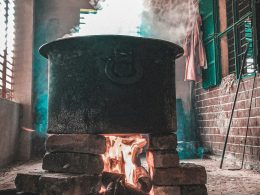
Meanwhile, 2.3 billion people still rely on polluting fuels and inefficient stoves. These practices generate around 2% of global greenhouse gases and contribute to millions of premature deaths annually due to household air pollution.
According to the International Energy Agency (IEA) and the UNFCCC, reaching global Net Zero by 2050 is not possible without addressing the climate impact of inefficient cooking. The IEA further estimates that achieving universal access to clean cooking by 2030 requires only about US $8 billion of investment each year, plus US $1.5 billion annually thereafter to sustain adoption. Yet current finance falls far short.
Relevant: Gold Standard Marks Milestone With First CORSIA-Eligible Carbon Credits
Clean cooking delivers much more than climate benefits. For individuals, using more advanced technologies like electric or ethanol stoves reduces the likelihood of diseases including childhood pneumonia, chronic obstructive pulmonary disorder, ischemic heart disease, stroke and lung cancer. For women and children in particular, it means hours each week collecting fuel – time that could be better spent on income generation, education or other activities.
This is confirmed by Chrissy Mavunga from Mbiya Stove Production Group, who said: “From the time-savings from collecting less firewood, we take care of the children, we make stoves, we weave mats and we have time for farming.”
Linking Flying and Cooking
Domestic cooking sits largely outside the productive economy, making it difficult to regulate or subsidise. The Carbon Credit Quality Initiative rates clean cooking as ‘5- star’ for additionality, recognising that these projects would not reach scale without carbon finance.
CORSIA provides a bridge, directing investment from a global industry with hard to-abate emissions to one of the most critical, underfunded areas of the energy transition. If the full 1.3–1.7 billion tonnes of emission reductions expected under CORSIA were sourced from high-quality clean cooking projects, the proceeds could generate US $25–35 billion in finance for household energy access, taking us a long way towards closing the global clean cooking funding gap.
Integrity First
Quality and integrity must underpin any expansion of CORSIA. As demand grows, airlines need confidence that every tonne purchased reflects real, conservative and verifiable reductions. Clean cooking has advanced significantly in recent years, supported by updated methodologies that strengthen monitoring, require transparent disclosure and apply conservative parameters including for baseline fuel use and non-renewable biomass. This enables buyers to ensure their finance flows only to projects that meet genuinely high standards.
Climate Action that Delivers
This is what the carbon market was designed to do: channel capital from where emissions are hardest to cut, to where finance can drive the greatest change. By supporting clean cooking projects applying recognised and high-quality methodologies, airlines can avoid ‘carbon tunnel vision’ and take climate action that also delivers for people and nature.
Read more: Aviation Sector Pushes For Host Authorization Under CORSIA Ahead Of 2027 Deadline