A new study published in Communications Sustainability indicates how simple nature-based interventions can increase tree growth in the earliest stages of reforestation.
The peer-reviewed publication also states that these interventions have the potential to boost the capture of carbon dioxide by 13% to 27% in the first four years of native woodland establishment.
These findings come from the Glandwr Forest Carbon Study, led by researchers at Imperial College London and science-based charity The Carbon Community.
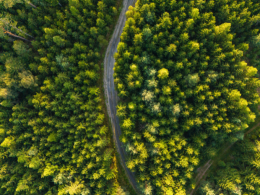
The study is the largest field trial of its kind on a global level, covering 72 individually managed research plots spread across a territory of 11.5 hectares / 28 acres of Welsh hillside, which equals 18 football pitches.
Through this work, the researchers are investigating CO2 sequestration in broadleaf and conifer forests put through two nature-based interventions, enhanced rock weathering (ERW) and microbial enrichment, each on its own and in combination.
The published results are based on the first four years of the reforestation study, and the initial insights focus on the CO2 stored above the ground in the trees.
In terms of enhanced rock weathering, or the spreading of crushed basalt on soil, this practice increased carbon removal significantly, with native woodland areas found to store up to 27% more aboveground CO2 after four years.
The researchers believe this approach likely improved tree nutrition by directly releasing calcium as the basaltic minerals weathered and by increasing the soil pH, which made existing nutrients such as nitrogen and phosphorus more available to the trees.
Relevant: New Oxford University-Backed Report Says Tropical Reforestation Outperforms Tech CDR
Additionally, the scientists noted that microbial enrichment demonstrated greatest impact during the key first year after planting, with some tree species benefiting more than others, especially spruce and oak.
The study results show that after four years, the broadleaf native woodland areas treated with microbial enrichment tended to store more CO2, with aboveground biomass 13% higher than those without this intervention.
This project stems from a long-term collaboration between The Carbon Community, researchers from Imperial College London, the Royal Botanic Gardens, Kew, and the University of Sheffield.
It was also supported by over 200 citizens, who voluntarily helped professional researchers collect data from 6,400 individually monitored trees annually as part of its ‘Big Tree Measure.’
Read more: U.S. Forest Carbon Buffer Pools Far Too Small For Climate Risks, Nature Study Warns