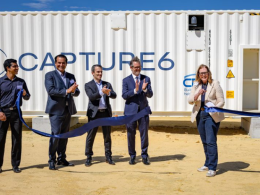
The Commonwealth Scientific and Industrial Research Organization (CSIRO), also known as Australia’s national science agency, has issued a new roadmap, outlining pathways and opportunities for advancing novel carbon dioxide removal (CDR) technologies in Australia.
Building on decades of CSIRO research on carbon management and innovation, the roadmap was put together with support from various partners, including the Department of Climate Change, Energy, the Environment, and Water; Google; Geoscience Australia; and the South Australian, Western Australian, and New South Wales state governments.
In it, CSIRO outlines the estimated capacity and cost for a selection of innovative CDR technologies, providing the next steps for developing and deploying them at scale in Australia.
The four novel CDR approaches included in the roadmap are direct air capture and storage, biomass carbon removal and storage, ocean alkalinity enhancement, and enhanced rock weathering.
Taking into consideration the country’s assets and resources, the guide highlights opportunities for deploying these technologies as a complementary tool to emissions reductions and nature-based CDR.
According to CSIRO CarbonLock Director and co-author Dr. Andrew Lenton, Australia operates with a set of natural resources and renewable energy assets that are favorable for the large-scale deployment of CDR, presenting an environment that only a few other global regions can match.
In his opinion, other emerging novel CDR approaches, such as mineral carbonation, will only strengthen Australia’s position.
Expert projections show that by 2050, Australia will require between 133 and 200 megatonnes of CDR to meet climate targets. In this regard, a model used in the roadmap shows that even with conservative projections, the novel technologies outlined in this report can potentially help Australia reach an annual CDR capacity of up to 330 Mt by 2050.
Relevant: Australia Sets 2035 Climate Target, Releases Net Zero Plan
The publication clarifies that only a portion of this volume would be required when combined with existing conventional CDR approaches.
To make this vision a reality, the country still needs substantial investment in technology development, resources, and infrastructure, along with specialized workforce development and elaborate community engagement.
This ambition will also require an overall supportive ecosystem, as well as strong international cooperation that would accelerate the deployment of these CDR innovations.
Read more: Arca Signs New Partnerships To Accelerate CDR In Western Australia Mining Sites