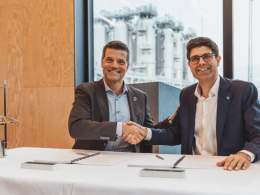
INEOS Energy and Royal Wagenborg have unveiled Europe’s first offshore carrier designed to transport liquefied CO2.
Named Carbon Destroyer 1, the ship will support Project Greensand, the EU’s first commercial-scale carbon capture and storage (CCS) value chain.
Christened at the Royal Niestern Sander shipyard in the Netherlands by Lady Catherine Ratcliffe, Carbon Destroyer 1 is based on Wagenborg’s EasyMax platform and engineered to carry CO2 under pressure at low temperatures, meeting top environmental and safety standards.
The vessel will connect CO2 emitters across Europe with offshore storage sites in Denmark’s North Sea, functioning as a “virtual pipeline.”
It will operate between a new CO2 terminal under construction in Esbjerg and the Nini West platform, with initial shipments expected by late 2025 or early 2026.
The Esbjerg facility will receive liquefied CO2 (LCO2) — starting with emissions from Danish biogas plants — via truck, store it on-site in six large tanks, and transfer it to the vessel for injection 1,800 meters (~5,905 ft) below the seabed.
Relevant: INEOS Sets Stage For $150M+ Investment In Carbon Capture Project Greensand
Carbon destroyer 1 will transport captured CO2 from across Europe, creating a virtual pipeline between the point of capture and permanent storage deep beneath the seabed of the North Sea,” said Mads Weng Gade, CEO of INEOS Energy Europe.
“The delivery of the first dedicated offshore CO2 carrier is a prerequisite for commercial scale CCS across the continent.”
The Greensand project is currently operated under the IRIS storage license by INEOS Energy Denmark, Harbour Energy, and Nordsøfonden — the Danish state-owned company responsible for managing subsurface resources.
Relevant: Svanehøj Wins CO2 Pump Contract for Project Greensand
The project works in collaboration with multiple partners to ensure that CO2 is effectively captured, transported, and permanently stored beneath the North Sea seabed.
In its early phase, Greensand Future plans to handle 400,000 tons of carbon emissions per year, reaching as much as 8 million tons of CO2 annually by 2030.