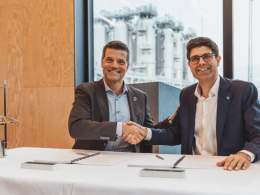
Honeywell will supply its carbon capture technology to a landmark project in Indiana that will convert a shuttered power plant into one of the United States’ first low-carbon hydrogen and ammonia production facilities. The initiative, led by Wabash Valley Resources (WVR), aims to bolster domestic fertilizer supply while cutting emissions at scale.
WVR recently secured a $1.559 billion US Department of Energy (DOE) loan, part of a federal effort to strengthen US energy independence by modernizing legacy industrial assets. The funding will support the restart and expansion of a former gasification plant in West Terre Haute, transforming it into a major producer of hydrogen-derived anhydrous ammonia.
At full capacity, the facility is expected to generate 500,000 metric tons of ammonia per year, helping meet agricultural demand across the Midwest. WVR projects the plant could replace half of current fertilizer imports for farmers in Illinois, Indiana, Ohio, and surrounding states, potentially easing price volatility in the region.
Large-Scale Carbon Capture for US Agriculture
Central to the project is Honeywell’s Advanced Solvent Carbon Capture (ASCC) technology, which will enable the facility to capture and permanently store nearly 1.65 million tons of CO2 annually.
According to Honeywell, that volume of CO2 is equivalent to the carbon absorbed by 1.65 million acres of US forest in a single year.
“As energy demand increases, Honeywell’s carbon capture technologies help customers like Wabash Valley Resources optimize operations and reduce emissions to help boost the domestic production of important inputs like ammonia to support American agriculture,” said Ken West, president and CEO of Honeywell Energy and Sustainability Solutions.
Relevant: Honeywell Partners With AM Green To Drive SAF And Carbon Capture In India
He emphasized that the project reflects the value of public-private partnerships in modernizing traditional energy and industrial sectors.
Dan Williams, CEO of WVR, said the facility will reinforce U.S. fertilizer security and advance cleaner production methods: “By utilizing Honeywell technology, we are paving the way for cleaner fertilizer production in the United States.”
SAMSUNG E&A is serving as engineering and design provider for the project and continues its collaboration with Honeywell to jointly market the ASCC technology. The facility is expected to be fully operational in 2028, positioning Indiana as a significant contributor to low-carbon ammonia production and US agricultural supply chain resilience.
Read more: Thyssenkrupp Uhde To Equip MOPCO Ammonia Plants With Carbon Capture