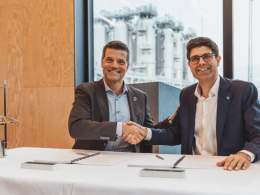
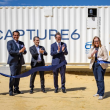




- Air Liquide has completed the “golden weld” connecting its Rozenburg industrial plant to the Porthos carbon dioxide transport pipeline in Rotterdam.
- The connection links Air Liquide’s proprietary Cryocap capture technology to the shared transport and offshore storage infrastructure.
- Air Liquide is one of four foundational customers for Porthos, alongside Shell, Air Products, and ExxonMobil.
Air Liquide has completed the “golden weld” connecting its industrial facility in Rozenburg to the Porthos CO2 pipeline, marking a major milestone in integrating capture, transport, and storage infrastructure in the Port of Rotterdam.
The company is currently constructing its carbon capture facility at the Rozenburg site, utilizing its proprietary Cryocap cryogenic technology to capture CO2 from industrial gas production.
Air Liquide stands as one of four anchor industrial customers for the Porthos CCS project, alongside Shell, Air Products, and ExxonMobil.
The physical pipeline hookup links the industrial capture plant directly into the collective Porthos gathering network, establishing the final onshore connection required to move captured emissions offshore.
Linking Onshore Industrial Emission Sources to North Sea Depleted Gas Fields
Once commercial operations begin, captured CO2 from the Rozenburg plant will flow through the shared gathering pipeline to a central compression station located at the Maasvlakte.
“We welcome this ‘golden weld’ as a true illustration of joint progress,” said Martijn Lub, Project Manager at Air Liquide.
Relevant: Dutch Porthos Project Prepares North Sea Gas Wells For CO2 Injection
“Large-scale decarbonization in the Port of Rotterdam requires strong, collective effort, and this connection to the Porthos CO2 pipeline shows what we can achieve when we collaborate together.”
At the Maasvlakte compressor station, the CO2 stream will be pressurized and dispatched via an offshore trunkline to the P18-A platform in the North Sea. The gas will then be permanently injected into depleted offshore natural gas reservoirs located roughly 3.5 kilometers (2.2. miles) beneath the seabed.
Read more: Air Liquide And Holcim Launch Industrial-Scale Carbon Capture Pilot For Cement