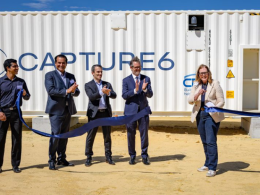
Frontier buyers have awarded $2 million in R&D grants to UK-based company Leilac and Swedish firm SaltX to support the production of zero-carbon lime that can be applied towards different carbon dioxide removal (CDR) approaches.
The awards were granted by Frontier on behalf of Stripe, Google, and Shopify, who aim to support the most low-cost and commercially ready systems for advancing zero-carbon lime as a way to stimulate the growth of CDR efforts.
Limestone is one of the most abundant rocks found on our planet. When heated, it creates quicklime, which interacts with CO2 emissions in the atmosphere or ocean waters, turning back into limestone that locks in the carbon dioxide away in solid rock form.
Due to its broad availability and naturally occurring CO2 removal capacities, quicklime presents a scalable solution that can boost the deployment of a range of CDR technologies, particularly ocean liming and certain types of direct air capture (DAC).
However, the conventional method of heating limestone to create CO2-tackling quicklime is actually carbon-intensive. When the limestone is put through a high-heat calciner that converts it into quicklime CO2 is released as a byproduct of this process.
Conventional calciners release the carbon emissions into the atmosphere through venting, and if the calciner itself is powered by fossil fuels, the released CO2 emissions significantly increase.
To address this carbon pollution, developers focused mainly on the needs of the cement industry have come up with electric calciners that reduce a portion of the emissions, but their running costs proved too high for this technology to be adopted more widely.
When designed specifically for carbon removal needs, which are less demanding than those of the cement industry, electric calcination systems have the potential to lower the cost of quicklime-driven CDR approaches.

Relevant: Limenet To Scale Operations With New $8.2 Million Funding
Both Leilac and SaltX have come up with innovative, low-carbon ways for converting limestone into either quicklime or alkaline products that are then used in CDR approaches centered around ocean alkalinity enhancement (OAE) or specific DAC systems, as well as a way to mitigate ocean acidification.
By backing these innovations with R&D grants, Frontier is supporting the advancement towards zero-carbon lime production with the intent of boosting further CDR scaling.
Read more: Nuada And MLC To Demonstrate Next-Gen Carbon Capture At UK Lime Facility