



Rotterdam’s Energy Transition Fund Rotterdam (ETF-R) has allocated €2 million (~$2.1 million) to fund innovative carbon capture technologies within the Port of Rotterdam.
This investment aims to bolster the capabilities of a carbon offloading and processing hub, ultimately leading to reduced emissions across the maritime industry.
The project, led by Rotterdam-based Value Group, utilizes a hybrid CO2 capture and exhaust cleaning system called Filtree.
This technology simultaneously captures and stores CO2 while removing harmful substances like sulfur, particulate matter, and oil residues from ships’ exhaust and washing water.
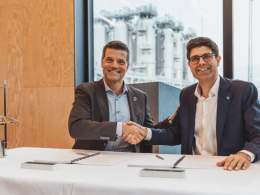
Maarten Lodewijks, co-founder and director of Value Group, expressed enthusiasm about the partnership with InnovationQuarter, stating, “With InnovationQuarter as a new shareholder, Value Group gains a strong strategic partner to accelerate the development of our Value Hub in Rotterdam for CO2 offloading and processing.”
Relevant: Value Maritime Launches World’s First CO2 Liquid Bunkering
The Value Hub, backed by ETF-R’s funding and InnovationQuarter‘s support, serves as a model for future carbon capture facilities.
A parallel pilot program demonstrates the system’s potential by using captured CO2 to enhance agricultural productivity in greenhouses.
Reinaud Struycken, senior investment manager at ETF-R, emphasized the technology’s potential for broader industrial applications. He highlighted, “Their innovative ’catch & release’ technology perfectly aligns with our vision for a cleaner and more sustainable Rotterdam.”
Relevant: MOL, Value Maritime To Launch First Carbon Capture System On Japanese Tanker
The development of the Value Hub marks a significant advancement in the CO2 value chain, integrating capture, storage, and reuse within a single operational framework.
Unlike other industry initiatives, which often focus solely on sequestration or limited recycling, this approach connects maritime emissions reduction with land-based applications like agriculture.
By establishing a closed-loop system, the Value Hub contributes to a broader decarbonization strategy. It sets a standard for other sectors seeking to implement scalable and efficient carbon management solutions.