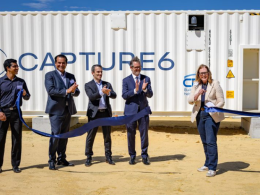





The US Department of Energy’s (DOE) Office of Fossil Energy and Carbon Management (FECM), in collaboration with DOE’s Hydrogen Fuel Cell Technologies Office (HFTO), has announced more than $58 million in federal funding for 11 projects to help develop a commercially viable carbon dioxide removal industry in the United States.
The funding is intended to support pilot projects and testing facilities that will demonstrate and scale carbon dioxide removal technologies aimed at reducing carbon dioxide (CO2) pollution by capturing it directly from the atmosphere.
“Alongside strong actions to lower carbon dioxide emissions from industry and power generation, large-scale deployment of carbon dioxide removal technology is crucial to achieving the Biden-Harris Administration’s climate and clean energy goals,” said Brad Crabtree, Assistant Secretary of Fossil Energy and Carbon Management.
“By investing in these pilot-scale projects, DOE aims to expand our technology portfolio and drive down costs of carbon dioxide removal, while also taking the care to evaluate any impacts of this technology on our environment and local communities.”
To support the emerging carbon dioxide removal industry, DOE launched the Carbon Negative Shot in 2021, marking the U.S. government’s first major effort toward carbon dioxide removal. This initiative is part of DOE’s larger Energy Earthshots Initiative, with the Carbon Negative Shot setting a goal to reduce the cost of CO2 removal from the atmosphere to less than $100 per net metric ton of CO2-equivalent by 2032. The initiative also emphasizes robust measurement, monitoring, reporting, verification, and secure storage.
The selected projects aim to support the objectives of the Carbon Negative Shot through integrated pilot-scale testing of advanced technologies and the development of detailed monitoring, reporting, and verification protocols.
Key Projects:
• Mote, Inc. (Los Angeles, California): This project will utilize wood waste to demonstrate a gasification system for hydrogen production coupled with CO2 capture.
• Arbor Energy and Resources Corporation (El Segundo, California): This project will utilize unmarketable forest waste from land management practices, storing the inherent carbon in the biomass while producing power using a supercritical CO2 power system.
• Carba, Inc. (Minneapolis, Minnesota): This project will convert biomass into charcoal to demonstrate permanent CO2 storage as solid carbon in oxygen-free chambers.
• Carbon Lockdown Project Benefit LLC (Silver Spring, Maryland): This project will implement pilot biomass burial projects at three Appalachian sites, demonstrating the use of residual biomass for carbon removal.
• Clemson University (Clemson, South Carolina): This project will demonstrate the injection of wood particles into the subsurface to remove carbon from the atmosphere and store it geologically.
Enhanced Mineralization Technologies:
• Stanford University (Stanford, California): The project will test a new enhanced weathering technology to enable rapid, scalable carbon dioxide removal in soil, storing it as bicarbonate ions.
• Eion Corp (Princeton, New Jersey): The project will implement a digital platform for measurement, reporting, and verification of terrestrial enhanced weathering technology.
• Lithos Carbon (Dover, Delaware): The project will apply enhanced rock weathering on over 3,000 acres of agricultural land in the southeastern U.S., notably North Carolina.
• Northwestern University (Chicago, Illinois): The project will demonstrate an innovative enhanced weathering method that helps Midwest farmers store atmospheric CO2 as dissolved bicarbonate.
Relevant: Meta Answers DOE’s Carbon Removal Challenge With $35M Pledge
Testbed Facilities:
• Arizona State University (Tempe, Arizona): The project will expand its existing testbed to evaluate direct air capture systems for geologic storage or mineralization, biomass-based carbon dioxide removal for use in biochar, low-carbon concrete, and asphalt materials, as well as marine CO2 removal pathways.
• University of North Dakota Energy & Environmental Research Center (Grand Forks, North Dakota): The project will expand its existing test facilities to transition carbon dioxide removal technologies from laboratory-scale concepts to integrated pilot-scale systems.
These projects are part of the larger push to innovate and scale technologies that can significantly reduce CO2 levels in the atmosphere, supporting the broader goal of achieving net-zero emissions.
Read more: Gevo Secures $1.5 Billion DOE Funding For Net-Zero Sustainable Aviation Fuel Plant