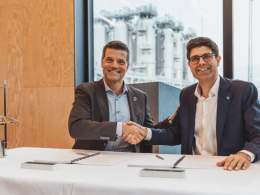





British Steel has initiated a pilot test of a mobile carbon capture unit developed by the University of Sheffield.
The unit will extract CO2 from the boiler flue at the Central Power Station in Scunthorpe and will then be bottled and sent to the University as feedstock for synthetic fuels.
Dr Andy Trowsdale, British Steel’s Head of Research and Development, said: “This project is all about testing the capabilities of the technology. If it works for us, and others, it could be scaled-up and play an important role in carbon capture, utilisation and storage.
“The trial, which has been approved by the Environment Agency, will demonstrate the technology’s potential. We’re excited to be working with the University of Sheffield and supporting such vital research.”
British Steel part of University of Sheffield’s mutliple carbon capture and removal trials
The project is one of many CO2 capture and removal initiatives being explored by the University of Sheffiled. Steelmaking is among the heavy and hard-to-abate industries with a large amount of emissions, and even though there is substantial progress and expectation that electrification will reduce 75% of emissions carbon capture is seen as a vital part of the solution.
This particular technology, called FluRefin, is the brainchild of Professor Peter Styring and Dr George Dowson from the University of Sheffield in partnership with AESSEAL – the Rotherham-based seal manufacturer.
One of the other advantages of the approach is that the end product is dry carbon dioxide, making it safer and easier to transport.
“We are excited to get our next generation carbon dioxide capture and refining technology on site. We look forward to being able to demonstrate a unique approach to further reducing British Steel’s CO2e emissions,” said Professor Peter Styring, Professor of Chemical Engineering and Chemistry at the University of Sheffield.
The University is also involved in exploring carbon capture from energy-from-waste with Professor Mathieu Lucquiaud’s research exploring the viability of TWICS (Transforming Waste Into a Climate Solution).
Direct air capture (DAC) – a method involving the removal of CO2 from ambient air – is also something being developed by the University.
In 2023 Mission Zero Technologies announced the deployment of its first commercially-financed DAC system in the UK. The system was previously sold to the University of Sheffield’s Translational Energy Research Centre (TERC) in order to progress work on an end-to-end production of jet fuel made from atmospheric carbon.
UK investing heavily in carbon capture
The UK government recently made a massive pledge of nearly £22 billion (~ $28.5B) to fund carbon capture and storage (CCS) projects.
The funding is directed at two heavy industry clusters at Teeside and Merseyside and will begin in 2028 and stretch over a 25-year period. The move is seen as providing assurance to investors that there will be long-term support and immediately derisking CCS projects which are capital intensive.
Offshore Energies UK have previously shared that the carbon capture sector has the potential to create 50,000 new jobs and guarantee a further 100,000 across different industries in the UK, building a supply chain worth £100 billion by 2050.
Read more: UK Government To Make Massive $28.5 Billion Carbon Capture Investment