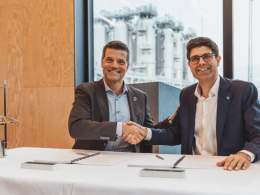
The American Bureau of Shipping (ABS) has issued an approval in principle (AiP) for a novel offshore facility designed by MODEC, Inc. in partnership with Mitsui O.S.K. Lines (MOL).
The floating storage and injection unit (FSIU) is engineered to support the carbon capture, utilization, and storage (CCUS) chain by providing direct offshore injection, eliminating the need for land-based terminals.
Built to handle up to 10 million tons of carbon dioxide each year, the unit incorporates tanks with at least 100,000 cubic meters of total capacity. ABS evaluated the concept against its classification rules and international statutory requirements before issuing the approval.
Miguel Hernandez, ABS Senior Vice President for Global Offshore, highlighted the importance of such technology in meeting international climate goals: “Carbon capture is advancing rapidly, with the International Energy Association projecting global capacity to reach 435 million tonnes per year by 2030. Floating storage and injection units, such as MODEC‘s innovative design, will be important for enabling the safe and efficient sequestration of captured carbon.”
A New Model for Offshore Carbon Storage
At the heart of the design is the ability to receive liquefied CO2 delivered by carriers, pressurize it for storage, and inject it directly into subsea reservoirs for long-term containment. The vessel’s configuration supports both tandem and side-by-side loading, ensuring continuous operations even under demanding conditions.
To minimize its own environmental footprint, the FSIU is equipped with diesel generators coupled with onboard carbon capture.
According to MODEC’s Vice President of Business and Project Development, Arata Kamishohara, the concept draws on the company’s experience with floating production, storage, and offloading (FPSO) systems, as well as previous CO2 injection projects.
Relevant: U.S. Threatens Tariffs In Battle Over Global Shipping Carbon Tax
Collaboration with MOL ensures seamless integration with the maritime transport side of the CCUS chain. MODEC aims to drive costs down to roughly $5 per ton of CO2 managed, a benchmark it sees as within reach.
ABS, headquartered in Texas, develops technical standards for shipping and offshore structures worldwide.
Tokyo-based MODEC specializes in floating production systems, while MOL operates one of the world’s largest fleets across bulk, tanker, container, and energy shipping sectors.
Read more: Seabound Launches World-First Onboard Carbon Capture System For Cement Shipping